Vector-valued function
Vector-valued function
A vector-valued function, also referred to as a vector function, is a mathematical function of one or more variables whose range is a set of multidimensional vectors or infinite-dimensional vectors. The input of a vector-valued function could be a scalar or a vector (that is, the dimension of the domain could be 1 or greater than 1); the dimension of the function's domain has no relation to the dimension of its range.
Example: Helix[edit]

A common example of a vector-valued function is one that depends on a single real parameter t, often representing time, producing a vector v(t) as the result. In terms of the standard unit vectors i, j, k of Cartesian 3-space, these specific types of vector-valued functions are given by expressions such as


The vector shown in the graph to the right is the evaluation of the function near t = 19.5 (between 6π and 6.5π; i.e., somewhat more than 3 rotations). The helix is the path traced by the tip of the vector as t increases from zero through 8π.

In 2D, We can analogously speak about vector-valued functions as


Linear case[edit]
In the linear case the function can be expressed in terms of matrices:

where y is an n × 1 output vector, x is a k × 1 vector of inputs, and A is an n × k matrix of parameters. Closely related is the affine case (linear up to a translation) where the function takes the form

where in addition b is an n × 1 vector of parameters.
The linear case arises often, for example in multiple regression[clarification needed], where for instance the n × 1 vector of predicted values of a dependent variable is expressed linearly in terms of a k × 1 vector (k < n) of estimated values of model parameters:


in which X (playing the role of A in the previous generic form) is an n × k matrix of fixed (empirically based) numbers.
Parametric representation of a surface[edit]
A surface is a 2-dimensional set of points embedded in (most commonly) 3-dimensional space. One way to represent a surface is with parametric equations, in which two parameters s and t determine the three Cartesian coordinates of any point on the surface:

Here F is a vector-valued function. For a surface embedded in n-dimensional space, one similarly has the representation

Derivative of a three-dimensional vector function[edit]
Many vector-valued functions, like scalar-valued functions, can be differentiated by simply differentiating the components in the Cartesian coordinate system. Thus, if



Partial derivative[edit]
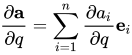
The partial derivative of a vector function a with respect to a scalar variable q is defined as[1]
Ordinary derivative[edit]
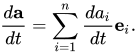
If a is regarded as a vector function of a single scalar variable, such as time t, then the equation above reduces to the first ordinary time derivative of a with respect to t,[1]
Total derivative[edit]
If the vector a is a function of a number n of scalar variables qr (r = 1, ..., n), and each qr is only a function of time t, then the ordinary derivative of a with respect to t can be expressed, in a form known as the total derivative, as[1]
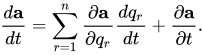
Some authors prefer to use capital D to indicate the total derivative operator, as in D/Dt. The total derivative differs from the partial time derivative in that the total derivative accounts for changes in a due to the time variance of the variables qr .
Reference frames[edit]
Whereas for scalar-valued functions there is only a single possible reference frame, to take the derivative of a vector-valued function requires the choice of a reference frame (at least when a fixed Cartesian coordinate system is not implied as such). Once a reference frame has been chosen, the derivative of a vector-valued function can be computed using techniques similar to those for computing derivatives of scalar-valued functions. A different choice of reference frame will, in general, produce a different derivative function. The derivative functions in different reference frames have a specific kinematical relationship.


Comments
Post a Comment