Derivative of a vector function with nonfixed bases
Derivative of a vector function with nonfixed bases[edit]
The above formulas for the derivative of a vector function rely on the assumption that the basis vectors e1, e2, e3 are constant, that is, fixed in the reference frame in which the derivative of a is being taken, and therefore the e1, e2, e3 each has a derivative of identically zero. This often holds true for problems dealing with vector fields in a fixed coordinate system, or for simple problems in physics. However, many complex problems involve the derivative of a vector function in multiple moving reference frames, which means that the basis vectors will not necessarily be constant. In such a case where the basis vectors e1, e2, e3 are fixed in reference frame E, but not in reference frame N, the more general formula for the ordinary time derivative of a vector in reference frame N is[1]
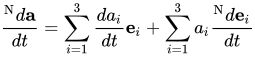
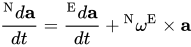
One common example where this formula is used is to find the velocity of a space-borne object, such as a rocket, in the inertial reference frame using measurements of the rocket's velocity relative to the ground. The velocity NvR in inertial reference frame N of a rocket R located at position rR can be found using the formula


Derivative and vector multiplication[edit]
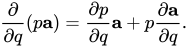
The derivative of a product of vector functions behaves similarly to the derivative of a product of scalar functions.[2] Specifically, in the case of scalar multiplication of a vector, if p is a scalar variable function of q,[1]
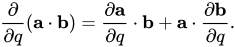
In the case of dot multiplication, for two vectors a and b that are both functions of q,[1]
Similarly, the derivative of the cross product of two vector functions is[1]

Derivative of an n-dimensional vector function[edit]
A function f of a real number t with values in the space can be written as . Its derivative equals


- .

If f is a function of several variables, say of , then the partial derivatives of the components of f form a matrix called the Jacobian matrix of f.


Infinite-dimensional vector functions[edit]
If the values of a function f lie in an infinite-dimensional vector space X, such as a Hilbert space, then f may be called an infinite-dimensional vector function.
Functions with values in a Hilbert space[edit]
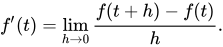
If the argument of f is a real number and X is a Hilbert space, then the derivative of f at a point t can be defined as in the finite-dimensional case:
Most results of the finite-dimensional case also hold in the infinite-dimensional case too, mutatis mutandis. Differentiation can also be defined to functions of several variables (e.g., or even , where Y is an infinite-dimensional vector space).


N.B. If X is a Hilbert space, then one can easily show that any derivative (and any other limit) can be computed componentwise: if

(i.e., , where is an orthonormal basis of the space X ), and exists, then



- .

However, the existence of a componentwise derivative does not guarantee the existence of a derivative, as componentwise convergence in a Hilbert space does not guarantee convergence with respect to the actual topology of the Hilbert space.
Other infinite-dimensional vector spaces[edit]
Most of the above hold for other topological vector spaces X too. However, not as many classical results hold in the Banach space setting, e.g., an absolutely continuous function with values in a suitable Banach space need not have a derivative anywhere. Moreover, in most Banach spaces setting there are no orthonormal bases.


Comments
Post a Comment