Vector calculus
Vector calculus
 | This article includes a list of general references, but it lacks sufficient corresponding inline citations. (February 2016) |
| Part of a series of articles about |
| Calculus |
|---|
Vector calculus, or vector analysis, is concerned with differentiation and integration of vector fields, primarily in 3-dimensional Euclidean space The term "vector calculus" is sometimes used as a synonym for the broader subject of multivariable calculus, which spans vector calculus as well as partial differentiation and multiple integration. Vector calculus plays an important role in differential geometry and in the study of partial differential equations. It is used extensively in physics and engineering, especially in the description of electromagnetic fields, gravitational fields, and fluid flow.

Vector calculus was developed from quaternion analysis by J. Willard Gibbs and Oliver Heaviside near the end of the 19th century, and most of the notation and terminology was established by Gibbs and Edwin Bidwell Wilson in their 1901 book, Vector Analysis. In the conventional form using cross products, vector calculus does not generalize to higher dimensions, while the alternative approach of geometric algebra which uses exterior products does (see § Generalizations below for more).
Basic objects[edit]
Scalar fields[edit]
A scalar field associates a scalar value to every point in a space. The scalar is a mathematical number representing a physical quantity. Examples of scalar fields in applications include the temperature distribution throughout space, the pressure distribution in a fluid, and spin-zero quantum fields (known as scalar bosons), such as the Higgs field. These fields are the subject of scalar field theory.
Vector fields[edit]
A vector field is an assignment of a vector to each point in a space.[1] A vector field in the plane, for instance, can be visualized as a collection of arrows with a given magnitude and direction each attached to a point in the plane. Vector fields are often used to model, for example, the speed and direction of a moving fluid throughout space, or the strength and direction of some force, such as the magnetic or gravitational force, as it changes from point to point. This can be used, for example, to calculate work done over a line.
Vectors and pseudovectors[edit]
In more advanced treatments, one further distinguishes pseudovector fields and pseudoscalar fields, which are identical to vector fields and scalar fields, except that they change sign under an orientation-reversing map: for example, the curl of a vector field is a pseudovector field, and if one reflects a vector field, the curl points in the opposite direction. This distinction is clarified and elaborated in geometric algebra, as described below.
Vector algebra[edit]
The algebraic (non-differential) operations in vector calculus are referred to as vector algebra, being defined for a vector space and then globally applied to a vector field. The basic algebraic operations consist of:
| Operation | Notation | Description |
|---|---|---|
| Vector addition | Addition of two vectors, yielding a vector. | |
| Scalar multiplication | Multiplication of a scalar and a vector, yielding a vector. | |
| Dot product | Multiplication of two vectors, yielding a scalar. | |
| Cross product | Multiplication of two vectors in , yielding a (pseudo)vector. |


Also commonly used are the two triple products:
| Operation | Notation | Description |
|---|---|---|
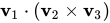
| Scalar triple product | The dot product of the cross product of two vectors. | |
| Vector triple product | The cross product of the cross product of two vectors. |

Operators and theorems[edit]
Differential operators[edit]
Vector calculus studies various differential operators defined on scalar or vector fields, which are typically expressed in terms of the del operator (), also known as "nabla". The three basic vector operators are:[2]

| Operation | Notation | Description | Notational analogy | Domain/Range |
|---|---|---|---|---|
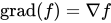
| Gradient | Measures the rate and direction of change in a scalar field. | Scalar multiplication | Maps scalar fields to vector fields. | |
| Divergence | Measures the scalar of a source or sink at a given point in a vector field. | Dot product | Maps vector fields to scalar fields. | |
| Curl | Measures the tendency to rotate about a point in a vector field in . | Cross product | Maps vector fields to (pseudo)vector fields. | |
| f denotes a scalar field and F denotes a vector field | ||||


Also commonly used are the two Laplace operators:
| Operation | Notation | Description | Domain/Range |
|---|---|---|---|
| Laplacian | Measures the difference between the value of the scalar field with its average on infinitesimal balls. | Maps between scalar fields. | |
| Vector Laplacian | Measures the difference between the value of the vector field with its average on infinitesimal balls. | Maps between vector fields. | |
| f denotes a scalar field and F denotes a vector field | |||


A quantity called the Jacobian matrix is useful for studying functions when both the domain and range of the function are multivariable, such as a change of variables during integration.
Integral theorems[edit]
The three basic vector operators have corresponding theorems which generalize the fundamental theorem of calculus to higher dimensions:
| Theorem | Statement | Description | ||
|---|---|---|---|---|
| Gradient theorem | The line integral of the gradient of a scalar field over a curve L is equal to the change in the scalar field between the endpoints p and q of the curve. | |||
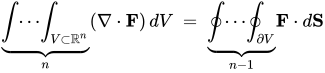
| Divergence theorem | The integral of the divergence of a vector field over an n-dimensional solid V is equal to the flux of the vector field through the (n−1)-dimensional closed boundary surface of the solid. | |||
| Curl (Kelvin–Stokes) theorem | The integral of the curl of a vector field over a surface Σ in is equal to the circulation of the vector field around the closed curve bounding the surface. | |||
| denotes a scalar field and F denotes a vector field | ||||
![{\displaystyle \int _{L\subset \mathbb {R} ^{n}}\!\!\!\nabla \varphi \cdot d\mathbf {r} \ =\ \varphi \left(\mathbf {q} \right)-\varphi \left(\mathbf {p} \right)\ \ {\text{ for }}\ \ L=L[p\to q]}](https://wikimedia.org/api/rest_v1/media/math/render/svg/e6256210d4ba35dd4b15ebac17aaa3445b8ee38a)


In two dimensions, the divergence and curl theorems reduce to the Green's theorem:
| Theorem | Statement | Description | ||
|---|---|---|---|---|
| Green's theorem | The integral of the divergence (or curl) of a vector field over some region A in equals the flux (or circulation) of the vector field over the closed curve bounding the region. | |||
| For divergence, F = (M, −L). For curl, F = (L, M, 0). L and M are functions of (x, y). | ||||


Applications[edit]
Linear approximations[edit]
Linear approximations are used to replace complicated functions with linear functions that are almost the same. Given a differentiable function f(x, y) with real values, one can approximate f(x, y) for (x, y) close to (a, b) by the formula

The right-hand side is the equation of the plane tangent to the graph of z = f(x, y) at (a, b).


Comments
Post a Comment